
Villanova Men's Basketball
Villanova Prepares for Mirror Image Utah State

Villanova Men’s Basketball has almost no history with Utah State, the Mountain West champion and their opening round draw in the NCAA Tournament: the Aggies defeated the Wildcats 73-72 in the NIT in 1960, their only previous matchup.
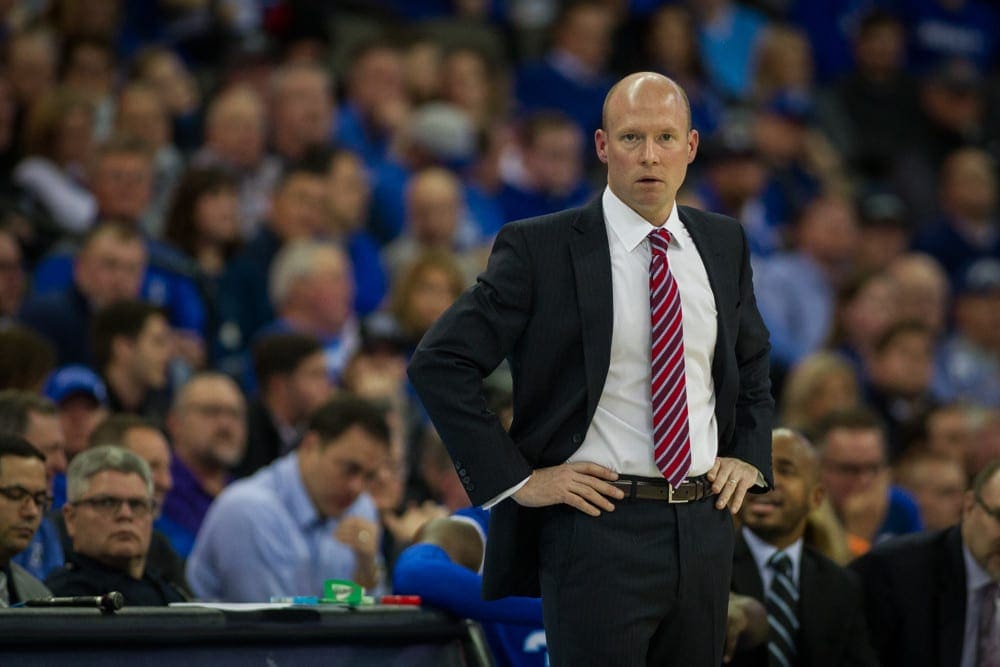
Two days removed from the selection show, however, the Wildcats have had a chance to learn Utah State’s tendencies through film review. Head coach Kevin Willard said he sees a reflection of his own team in the Aggies, another guard-centric team. Utah State’s offense runs through guards Malik Collins Jr. and Mason Falslev, a pair of 6-foot-4 upperclassmen averaging more than 16 points per game apiece. Willard complimented Collins specifically for his accuracy and catch-and-shoot ability.
“Experienced, really good guards. Physical guards. Play a lot of guys and unique defense, and the fact that it’s a little bit like what we try to play, but they have experienced guys that have been in it, so they’re really good at it,” Willard said.
“Really good at trading off and switching guys. Very good basketball team… They’re really good at getting into the paint too, and I think that’s why they shoot the basketball so well. So I think we’re gonna have to do a really good job of keeping them out of the paint. They have big, physical guards that can get downhill and get in there.”
Villanova junior guard Tyler Perkins will have a full plate squaring off against his Aggies’ counterparts, but said the nature of Big East play prepared him for the matchup.
“I feel like we’re ready for it. That’s what the Big East is. It’s all physical, tough guards,” Perkins said. “We practice against each other all the time, beating each other up and stuff like that, so we’re used to it.”
Aggies’ Advantages
Utah State takes 41 percent of their shots from three, making 35.8 percent of them. That’s a potential weakness for the Wildcats’ up-and-down three-point defense. It also provides an opportunity for a Villanova team that struggles on the glass. Lead rebounder Duke Brennan said the Wildcats’ guards can help pick up the slack if the Aggies try to show off their range.
“Those guys like A-Lew, Bryce Lindsay, need to get in there,” Brennan said. “The long rebounds, you know, especially in March Madness, people are going to be taking a lot of threes. Long shots equal long rebounds.”
Starting forward Matt Hodge tore his ACL on Feb. 28, another blow to the undersized Wildcats… but one that they’ll have an easier time surviving against another small-ball team like the Aggies. None of Utah State’s forwards play more than 20 minutes per game: starters Adlan Elamin and Zach Keller average just 19.0 and 13.8 minutes, respectively.
However, the Aggies have a stable of forwards ready to rotate in. Garry Clark and Karson Templin, both 6-foot-9, add 16.5 and 18.7 minutes apiece. Willard described the matchup down low.
“I think that’s what they do best. I mean, they’re deep. You still got to, you still really got to defend, gotta focus on their three guards, because those guys, they can get you at any time,” Willard said. “Their fours and fives are a problem, because they do play a lot of them. But they’re not involved in so much of the offense as the other guys are.”
Filling in for Matt Hodge
When Hodge went down for the season, Willard turned to 6-foot-6 wing Malachi Palmer to fill the open minutes. While Palmer faces a size disadvantage trying to play the four, Willard said the real problems start when the sophomore heads to the bench. At that point, Villanova doesn’t have a next man up, although he’s tried playing Perkins at the four instead.
Even though Hodge isn’t available for Villanova on the court, Perkins said the injured forward is helping him adjust his game and account for that absence.
“Just trying to learn from Matt, see what worked for him at the four. It’s obviously big, physical guys at that small forward, power forward… Just having to understand how to use my body and use my size. I used to be able to kind of bully some smaller guards, but now I’m going up against bigger forwards,” Perkins said.
“And then boxing out, you’ve really gotta box out at that position… He just kinda shows me areas where I can be better and use my size, and things that work for him. He’s a shooter, so just trying to understand how he can dictate getting his shot off and stuff like that.”
Perkins said he makes sure to return the favor, watching out for his teammate as he deals with the disappointment of an injury on the eve of postseason play.
“At the end of the day I’ve just been trying to be there for Matt Hodge.” Perkins said. “It’s been tough for him, but he’s doing good and I’m glad he’s getting through it.”
Secret Weapons
Before transferring to Villanova, Brennan spent two seasons at Grand Canyon University. The ‘Lopes moved from the WAC to the Mountain West this past offseason so, while Brennan never played against Utah State, his former teammates and staffers know the Aggies and head coach Jerrod Calhoun’s system.
Brennan said he made sure to take advantage of the connection.
“I talked to some of them, I talked to some managers over there and stuff like that because they played them twice, they actually beat them,” Brennan said.
“They thought it was funny that I’m playing them, especially on the West Coast out there. I think actually some of them are about to come out to that game. So it’s going to be good, but they gave me some little insight and little tips and stuff like that. We’ll keep it under wraps, but we got some inside information for sure.”
As one of the seasoned veterans on this young Villanova team, Brennan said he enjoys the pressure of big moments. However, he added that he and his teammates can’t let the spotlight overwhelm them.
“Pressure is a privilege, that’s what is hung on my wall at home, actually. Just taking that pressure, especially in those March Madness games, the lights are on, everyone’s watching, and just embracing the moment. You can’t be scared of the moment. If you’re scared for a second in the moment, that’s where the ship will turn,” Brennan said.
“Going out there and playing the game that you played all year. We’ve played thirty plus games or whatever we played and it can’t be a different approach to this game. You have to go out and do the same things you’ve been working on since the summer.”